# ASAP
[](https://travis-ci.org/kriskowal/asap)
Promise and asynchronous observer libraries, as well as hand-rolled callback
programs and libraries, often need a mechanism to postpone the execution of a
callback until the next available event.
(See [Designing API’s for Asynchrony][Zalgo].)
The `asap` function executes a task **as soon as possible** but not before it
returns, waiting only for the completion of the current event and previously
scheduled tasks.
```javascript
asap(function () {
// ...
});
```
[Zalgo]: http://blog.izs.me/post/59142742143/designing-apis-for-asynchrony
This CommonJS package provides an `asap` module that exports a function that
executes a task function *as soon as possible*.
ASAP strives to schedule events to occur before yielding for IO, reflow,
or redrawing.
Each event receives an independent stack, with only platform code in parent
frames and the events run in the order they are scheduled.
ASAP provides a fast event queue that will execute tasks until it is
empty before yielding to the JavaScript engine's underlying event-loop.
When a task gets added to a previously empty event queue, ASAP schedules a flush
event, preferring for that event to occur before the JavaScript engine has an
opportunity to perform IO tasks or rendering, thus making the first task and
subsequent tasks semantically indistinguishable.
ASAP uses a variety of techniques to preserve this invariant on different
versions of browsers and Node.js.
By design, ASAP prevents input events from being handled until the task
queue is empty.
If the process is busy enough, this may cause incoming connection requests to be
dropped, and may cause existing connections to inform the sender to reduce the
transmission rate or stall.
ASAP allows this on the theory that, if there is enough work to do, there is no
sense in looking for trouble.
As a consequence, ASAP can interfere with smooth animation.
If your task should be tied to the rendering loop, consider using
`requestAnimationFrame` instead.
A long sequence of tasks can also effect the long running script dialog.
If this is a problem, you may be able to use ASAP’s cousin `setImmediate` to
break long processes into shorter intervals and periodically allow the browser
to breathe.
`setImmediate` will yield for IO, reflow, and repaint events.
It also returns a handler and can be canceled.
For a `setImmediate` shim, consider [YuzuJS setImmediate][setImmediate].
[setImmediate]: https://github.com/YuzuJS/setImmediate
Take care.
ASAP can sustain infinite recursive calls without warning.
It will not halt from a stack overflow, and it will not consume unbounded
memory.
This is behaviorally equivalent to an infinite loop.
Just as with infinite loops, you can monitor a Node.js process for this behavior
with a heart-beat signal.
As with infinite loops, a very small amount of caution goes a long way to
avoiding problems.
```javascript
function loop() {
asap(loop);
}
loop();
```
In browsers, if a task throws an exception, it will not interrupt the flushing
of high-priority tasks.
The exception will be postponed to a later, low-priority event to avoid
slow-downs.
In Node.js, if a task throws an exception, ASAP will resume flushing only if—and
only after—the error is handled by `domain.on("error")` or
`process.on("uncaughtException")`.
## Raw ASAP
Checking for exceptions comes at a cost.
The package also provides an `asap/raw` module that exports the underlying
implementation which is faster but stalls if a task throws an exception.
This internal version of the ASAP function does not check for errors.
If a task does throw an error, it will stall the event queue unless you manually
call `rawAsap.requestFlush()` before throwing the error, or any time after.
In Node.js, `asap/raw` also runs all tasks outside any domain.
If you need a task to be bound to your domain, you will have to do it manually.
```js
if (process.domain) {
task = process.domain.bind(task);
}
rawAsap(task);
```
## Tasks
A task may be any object that implements `call()`.
A function will suffice, but closures tend not to be reusable and can cause
garbage collector churn.
Both `asap` and `rawAsap` accept task objects to give you the option of
recycling task objects or using higher callable object abstractions.
See the `asap` source for an illustration.
## Compatibility
ASAP is tested on Node.js v0.10 and in a broad spectrum of web browsers.
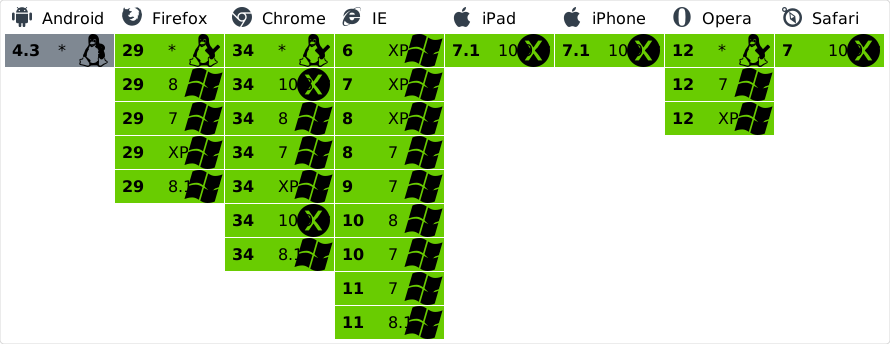
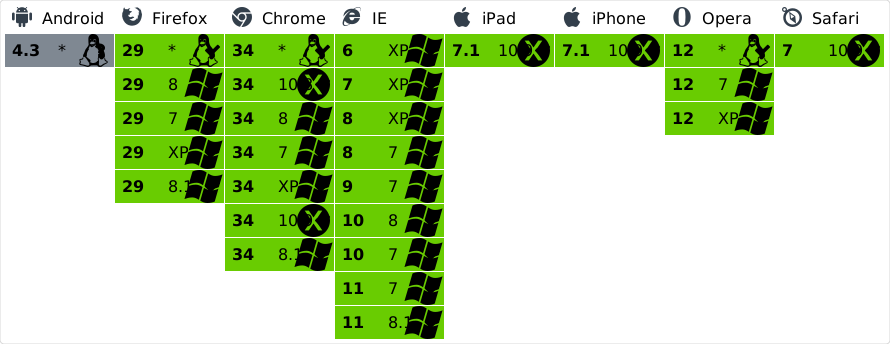
The following charts capture the browser test results for the most recent
release.
The first chart shows test results for ASAP running in the main window context.
The second chart shows test results for ASAP running in a web worker context.
Test results are inconclusive (grey) on browsers that do not support web
workers.
These data are captured automatically by [Continuous
Integration][].
[Continuous Integration]: https://github.com/kriskowal/asap/blob/master/CONTRIBUTING.md
## Caveats
When a task is added to an empty event queue, it is not always possible to
guarantee that the task queue will begin flushing immediately after the current
event.
However, once the task queue begins flushing, it will not yield until the queue
is empty, even if the queue grows while executing tasks.
The following browsers allow the use of [DOM mutation observers][] to access
the HTML [microtask queue][], and thus begin flushing ASAP's task queue
immediately at the end of the current event loop turn, before any rendering or
IO:
[microtask queue]: http://www.whatwg.org/specs/web-apps/current-work/multipage/webappapis.html#microtask-queue
[DOM mutation observers]: http://dom.spec.whatwg.org/#mutation-observers
- Android 4–4.3
- Chrome 26–34
- Firefox 14–29
- Internet Explorer 11
- iPad Safari 6–7.1
- iPhone Safari 7–7.1
- Safari 6–7
In the absense of mutation observers, there are a few browsers, and situations
like web workers in some of the above browsers, where [message channels][]
would be a useful way to avoid falling back to timers.
Message channels give direct access to the HTML [task queue][], so the ASAP
task queue would flush after any already queued rendering and IO tasks, but
without having the minimum delay imposed by timers.
However, among these browsers, Internet Explorer 10 and Safari do not reliably
dispatch messages, so they are not worth the trouble to implement.
[message channels]: http://www.whatwg.org/specs/web-apps/current-work/multipage/web-messaging.html#message-channels
[task queue]: http://www.whatwg.org/specs/web-apps/current-work/multipage/webappapis.html#concept-task
- Internet Explorer 10
- Safair 5.0-1
- Opera 11-12
In the absense of mutation observers, these browsers and the following browsers
all fall back to using `setTimeout` and `setInterval` to ensure that a `flush`
occurs.
The implementation uses both and cancels whatever handler loses the race, since
`setTimeout` tends to occasionally skip tasks in unisolated circumstances.
Timers generally delay the flushing of ASAP's task queue for four milliseconds.
- Firefox 3–13
- Internet Explorer 6–10
- iPad Safari 4.3
- Lynx 2.8.7
## Heritage
ASAP has been factored out of the [Q][] asynchronous promise library.
It originally had a naïve implementation in terms of `setTimeout`, but
[Malte Ubl][NonBlocking] provided an insight that `postMessage` might be
useful for creating a high-priority, no-delay event dispatch hack.
Since then, Internet Explorer proposed and implemented `setImmediate`.
Robert Katić began contributing to Q by measuring the performance of
the internal implementation of `asap`, paying particular attention to
error recovery.
Domenic, Robert, and Kris Kowal collectively settled on the current strategy of
unrolling the high-priority event queue internally regardless of what strategy
we used to dispatch the potentially lower-priority flush event.
Domenic went on to make ASAP cooperate with Node.js domains.
[Q]: https://github.com/kriskowal/q
[NonBlocking]: http://www.nonblocking.io/2011/06/windownexttick.html
For further reading, Nicholas Zakas provided a thorough article on [The
Case for setImmediate][NCZ].
[NCZ]: http://www.nczonline.net/blog/2013/07/09/the-case-for-setimmediate/
Ember’s RSVP promise implementation later [adopted][RSVP ASAP] the name ASAP but
further developed the implentation.
Particularly, The `MessagePort` implementation was abandoned due to interaction
[problems with Mobile Internet Explorer][IE Problems] in favor of an
implementation backed on the newer and more reliable DOM `MutationObserver`
interface.
These changes were back-ported into this library.
[IE Problems]: https://github.com/cujojs/when/issues/197
[RSVP ASAP]: https://github.com/tildeio/rsvp.js/blob/cddf7232546a9cf858524b75cde6f9edf72620a7/lib/rsvp/asap.js
In addition, ASAP factored into `asap` and `asap/raw`, such that `asap` remained
exception-safe, but `asap/raw` provided a tight kernel that could be used for
tasks that guaranteed that they would not throw exceptions.
This core is useful for promise implementations that capture thrown errors in
rejected promises and do not need a second safety net.
At the same time, the exception handling in `asap` was factored into separate
implementations for Node.js and browsers, using the the [Browserify][Browser
Config] `browser` property in `package.json` to instruct browser module loaders
and bundlers, including [Browserify][], [Mr][], and [Mop][], to use the
browser-only implementation.
[Browser Config]: https://gist.github.com/defunctzombie/4339901
[Browserify]: https://github.com/substack/node-browserify
[Mr]: https://github.com/montagejs/mr
[Mop]: https://github.com/montagejs/mop
## License
Copyright 2009-2014 by Contributors
MIT License (enclosed)
|